
From non-clinical data and formulation design to First-in-Human
PhinC supports development teams with PBPK and PBBM strategies to anticipate exposure, optimize doses, secure key decisions and strengthen regulatory dossiers.
Physiology-based pharmacokinetic modeling (PBPK)
For better translation from non-clinical to human.
A robust mechanistic ADME model
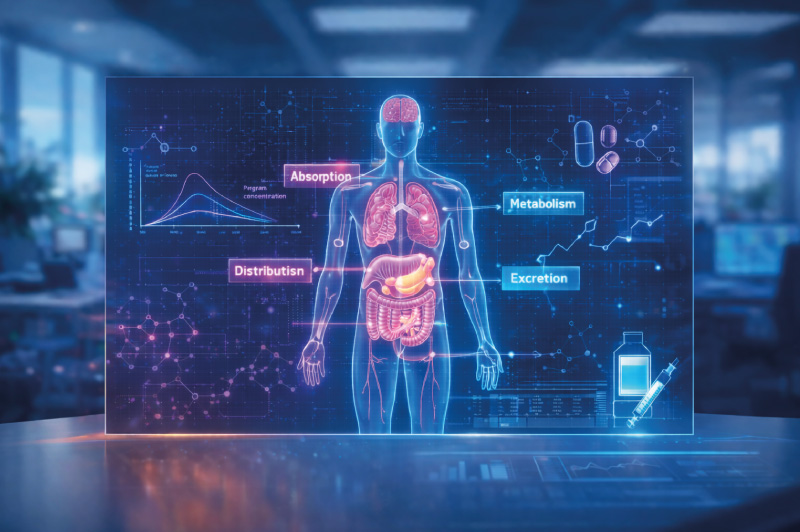
PBPK modeling predicts absorption, distribution, metabolism, and excretion by integrating molecule-specific properties and physiological system knowledge within a unified quantitative framework.
-
Anatomy and physiologyRepresentation of the human or animal body.
-
Physicochemical propertiesParameters influencing distribution and permeability.
-
In vitro BiotransformationEnzymes, metabolic pathways, intrinsic clearance.
-
Transportation processActive/passive transport across tissues.
Derisking early clinical development
PBPK supports dose and dosing regimen selection by explicitly considering physiology, in vitro metabolism/transport and inter-individual variability — reducing the need for extensive in vivo studies and accelerating turnaround times.
-
First-in-Human (FIH)Testing dose scenarios in silico before clinical execution.
-
Drug-Drug Interactions (DDI)Estimate the extent of the interactions and support the mitigation strategy.
-
Special populationsPediatrics, liver or kidney failure, and other situations.
-
Food & bridgingFood effect, change in formulation, justification for bridging.
Datasets that can be used quickly
Preclinical PK, animal studies, and in vitro metabolism and transport data provide a solid basis for starting a PBPK analysis.
Clear, submission-ready outputs.
Simulation reports, scenario comparisons, sensitivity analyses, full traceability of assumptions, and decision-oriented recommendations.
GastroPlus® Expertise
PhinC pioneered the use of GastroPlus® and maintains a strong partnership with Simulations Plus® to deploy best-practice PBPK workflows.
Physiology-based biopharmaceutical modeling (PBBM)
For a better translation from formulation design to in vivo performance
Mechanistic modeling of absorption and bioavailability
PBBM predicts absorption and bioavailability by integrating formulation characteristics with gastrointestinal physiology, allowing a quantitative link between in vitro observations and in vivo performance.
-
Physicochemical propertiesSolubility, permeability, stability (pKa, LogP).
-
Formulation modelsDissolution, particle size, release.
-
Gastrointestinal physiologypH, transit, first-pass effect, bile.
-
VariabilityAge, GI conditions, patient subgroups.
Optimize formulation and bioequivalence strategy
Formulation and manufacturing determine the consistency of absorption and success in bioequivalence. PBBM simulates the interaction between the active substance, the formulation matrix, and human physiology to guide development decisions.
-
CRDSClinically relevant dissolution specifications.
-
Virtual Bioequivalence (vBE)Virtual bioequivalence & formulation bridging.
-
BiowaiversMechanistic rationale, food effect, antacids.
-
ScreeningTest variants before clinical PK.
From API to in vitro dissolution
API characterization, solubility/permeability profiles, multi-media dissolution testing, and release rate assessments.
Design → simulate → de-risk
Evaluate formulation options and dissolution specifications in silico, then prioritize the most promising scenarios for clinical PK studies.
PBBM workflows in GastroPlus®
PhinC excels in delivering advanced PBBM using GastroPlus, supported by a long-standing collaboration with Simulations Plus.
Turn your data into robust PBPK/PBBM decisions
With PhinC, secure your key milestones through robust mechanistic modeling: dose selection, FIH scenarios, DDI strategy, formulation optimization, bioequivalence, and bridging. Our teams combine PBPK and PBBM expertise to deliver traceable, defensible, and decision-oriented analyses.